Curtains, Blinds and Nets in Durban: Measure and Buy Guide

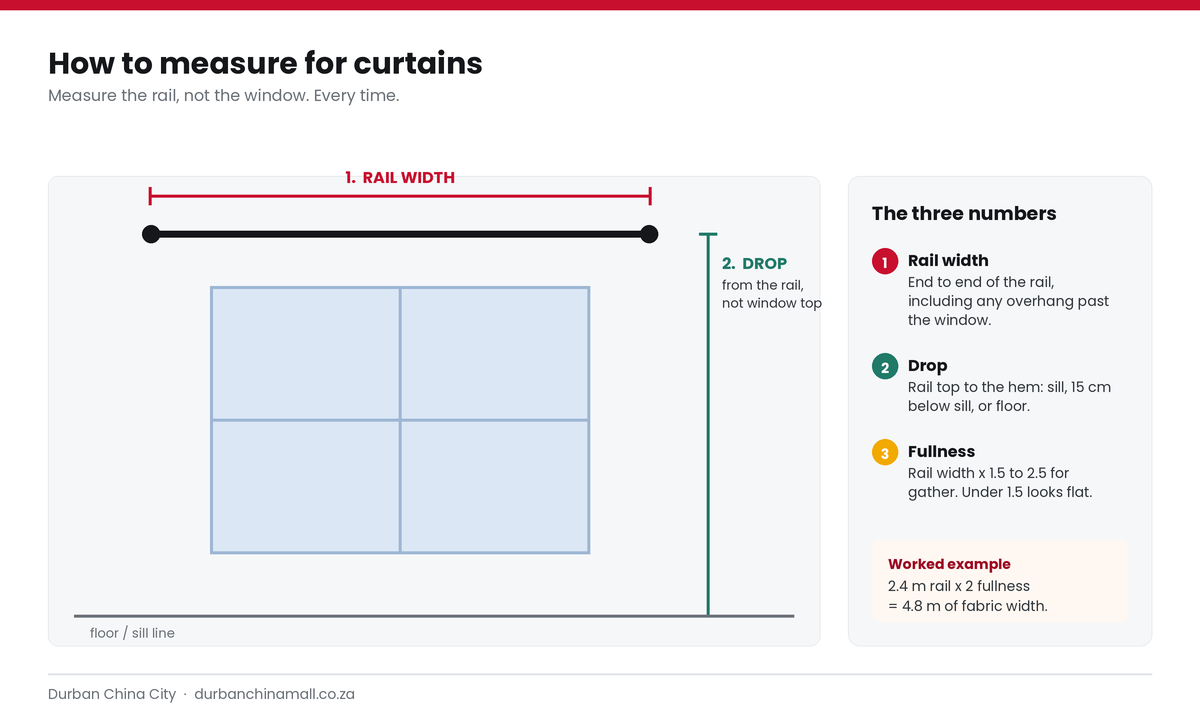
Measure your curtain rail, not your window. Multiply the rail width by 1.5 to 2.5 for fullness, then measure the drop from the rail to your chosen finish point and add 15cm to 25cm for hems. Ready-made curtain panels in Durban typically cost roughly R120 to R700 depending on drop and lining.
What this guide covers
- How to measure for curtains
- Step one: the rail width
- Step two: apply the fullness multiplier
- Step three: the drop
- Step four: add for hems
- Worked example
- Curtain types and what they are for
- Rails, rods, tracks and brackets
- Blinds: roller, venetian and bamboo
- Fabric by the metre versus ready-made
- Typical prices in Durban
- What to check for quality
- Hanging them yourself
- Curtain fitting as a small service business
- Frequently asked questions
- Measure twice, then come and buy
Most curtain disappointments come from one mistake: measuring the window instead of the rail. Curtains hang from the rail, and the rail should be wider and higher than the window. Measure the wrong thing and you will end up with panels that stop short, let light in at the edges and make the room look smaller.
The rule to remember: rail width multiplied by your fullness factor equals the total curtain width you need to buy. Fullness is 1.5 times for a light, flat look, 2 times for a normal gathered look and 2.5 times for a full, luxurious look. Then measure the drop from the rail down to where you want the curtain to end, and add for hems.
This guide covers measuring properly, the different curtain types and what they are for, rails and tracks, blinds and their trade-offs, fabric by the metre versus ready-made, what to check for quality, and how to hang them yourself without cracking the wall.
How to measure for curtains
Use a steel tape, not a fabric one, and write the numbers down in centimetres. Measure every window separately even if they look identical, because they very often are not.
Step one: the rail width
If the rail is already up, measure it end to end, excluding the decorative finials on a rod. If it is not up yet, decide where it will go first. A rail should extend roughly 15cm to 20cm past each side of the window opening, so the curtains stack back off the glass when open. That lets in more light and makes the window look wider.
Step two: apply the fullness multiplier
Curtains need more fabric than the space they cover, or they hang flat and look like a bedsheet.
| Fullness | Multiply rail width by | Look and best use |
|---|---|---|
| Light | 1.5x | Flat, economical. Fine for sheers and small windows |
| Standard | 2x | Proper gathers. The safe default for most rooms |
| Full | 2.5x | Deep folds, best for heavy fabric and formal rooms |
Step three: the drop
Measure from the top of the rail, or from the eye of the ring or the top of the eyelet, straight down to where you want the curtain to end. There are three normal finish points.
- To the sill. Ends level with the windowsill. Neat, practical over a radiator, a desk or a kitchen counter.
- Below the sill. Roughly 10cm to 15cm past the sill. The most forgiving option and the most common in ready-mades.
- To the floor. Ends 1cm to 2cm above the floor so it clears carpet and does not drag. Puddling on the floor looks good in photographs and collects dust in real life.
Step four: add for hems
If you are having curtains made or making them yourself, add roughly 15cm to 25cm to the drop for the top heading and the bottom hem, and about 5cm to 8cm per side for side hems. A deeper bottom hem hangs better because the weight pulls the fabric straight. If you are buying ready-mades, hems are already there, so buy the next drop up and take it up rather than buying short.
Worked example
A bedroom window, 1.8m wide. You want floor-length blockout curtains with standard fullness.
| Step | Working | Result |
|---|---|---|
| Window width | Measured | 180cm |
| Rail width | 180cm + 20cm each side | 220cm |
| Fabric width needed | 220cm x 2 fullness | 440cm |
| Per panel (two panels) | 440cm / 2 | 220cm each |
| Rail height | Fixed near the ceiling | 245cm from floor |
| Drop wanted | 245cm less 2cm floor clearance | 243cm |
| Cut length if sewing | 243cm + 20cm hems | 263cm |
So you need two panels of about 220cm width each, at a 243cm finished drop. If you are buying fabric by the metre you need roughly 5.3 metres of a wide fabric, plus a little extra to match any pattern repeat.
Photograph the tape held against the rail and the drop, with the numbers visible, before you leave home. Write the measurements on your phone too. Standing in a shop trying to remember whether the drop was 218 or 228 is how people buy the wrong curtains, and cut fabric is rarely returnable.
Curtain types and what they are for
Eyelet
Metal rings punched into the header, threaded straight onto a rod. The easiest to hang and slide, with deep even waves. It needs a rod rather than a track, and the ring size must fit your rod diameter.
Tape
A sewn header tape with draw cords you pull to gather the fabric, then hooks into a track or rings. The most flexible option, because you set your own fullness and can adjust it later. More work at hanging time, better looking when done well.
Rod pocket
A sewn channel at the top that the rod slides through. Cheap and neat, but the curtain does not slide easily, so it suits panels you rarely open, such as nets and dressing curtains.
Blockout
Woven or coated to stop light. Genuinely useful for bedrooms, shift workers, babies and west-facing rooms in Durban, where late afternoon sun heats a room badly. It helps a little with noise and heat too. Check the backing, because poor ones flake.
Sheers and nets
Voile, lace and net panels that let light through while giving daytime privacy. Usually hung on a second inner rail or track behind the main curtains. Buy them generously full, because nets look cheap when they are hung flat. Voile hangs better than stiff net.
Rails, rods, tracks and brackets
The hardware decides whether the curtain works. Pick it before you buy the fabric.
| Hardware | Works with | Notes |
|---|---|---|
| Metal or wooden rod | Eyelet, rings, rod pocket | Decorative, visible. Check diameter against eyelets |
| Plastic or metal track | Tape with hooks or gliders | Discreet, can be bent for bay windows |
| Double rail or track | Nets plus main curtains | The usual solution for sheer behind blockout |
| Tension or extendable rod | Light nets and voiles only | Will not hold heavy blockout |
| Ceiling-fix track | Any tape curtain | Best for floor-to-ceiling looks |
Buy extra brackets. A long rail needs a centre bracket or it sags, and heavy blockout curtains over a wide window need support roughly every metre. This is the cheapest part of the job and the part most often under-bought.
Blinds: roller, venetian and bamboo
- Roller blinds. Cheapest and simplest, and available in blockout. Good in kitchens, bathrooms and offices. The mechanism is the part that fails, so test the chain and bracket fit.
- Venetian blinds. Slats you tilt for light control without opening them. Excellent control, but they collect dust and each slat needs wiping. Aluminium dents, PVC yellows in strong sun.
- Bamboo and wooden blinds. Warm and natural, good on patios and verandas. They soften light rather than block it, and bamboo can warp in damp coastal conditions.
Blinds are usually measured inside the window recess, the opposite of curtains. Measure the recess width at the top, middle and bottom and use the smallest figure, because openings are rarely square. Many people combine a blind for light control with curtains for softness.
Fabric by the metre versus ready-made
Ready-mades are cheaper, faster and come in fixed drops. Fabric by the metre costs more once you add making-up, but you get exact drops, your own fullness and a far wider choice of fabric.
| Ready-made | Fabric by the metre | |
|---|---|---|
| Cost | Lower | Higher once made up |
| Fit | Fixed drops, may need taking up | Exact |
| Choice | Limited | Wide |
| Time | Same day | Days to weeks |
| Best for | Standard windows, rentals, budgets | Odd sizes, tall windows, a specific look |
A middle path many people take: buy ready-mades one drop longer than needed and have a dressmaker take up the hem. It costs very little and gets you an exact drop at ready-made prices. Our clothing, shoes and fabric guide covers buying fabric by the metre.
Typical prices in Durban
Everything below is a typical range at the time of writing, given as a planning aid. Every trader prices independently and prices move, so confirm on the day.
| Item | Small window | Standard window | Sliding door or large |
|---|---|---|---|
| Sheer or net panel | R60 – R160 | R100 – R280 | R180 – R500 |
| Lightweight ready-made panel | R100 – R220 | R150 – R380 | R280 – R650 |
| Blockout ready-made panel | R160 – R320 | R250 – R550 | R450 – R1,100 |
| Eyelet blockout pair | R280 – R550 | R400 – R900 | R700 – R1,800 |
| Roller blind | R120 – R300 | R180 – R550 | R400 – R1,200 |
| Venetian blind | R150 – R380 | R250 – R700 | R500 – R1,500 |
| Bamboo blind | R180 – R400 | R280 – R750 | R550 – R1,500 |
| Curtain fabric, per metre | R45 – R90 | R70 – R150 | R120 – R220 |
| Rail, rod or track | R80 – R180 | R120 – R300 | R200 – R450 |
Typical observed ranges only, not quotes or official prices. For context across other categories, see our China Mall Durban price guide.
What to check for quality
- Weight in the hand. Lift the panel. Heavier fabric hangs straighter, blocks more light and looks more expensive. Weight is the fastest quality signal there is.
- Hold it to the light. For blockout, hold a fold up to a light or a window. If you see the light through it, it is dimout, not blockout.
- Check the blockout backing. Rub and flex a corner. A coating that cracks, powders or flakes in the shop will peel off in the wash. A woven three-pass blockout lasts far better than a thin sprayed coating.
- Inspect the stitching. Straight, even, no puckering, no loose threads. Check the side hems and the bottom hem, which take the most stress. Double-stitched hems are worth paying for.
- Check the header. On eyelets, the rings should be firmly set with no fabric fraying at the punch. On tape, pull the cords gently to make sure they run.
- Colourfastness. Durban sun is hard on fabric. Deep reds, purples and bright blues fade fastest. Ask about washing, and be aware that unlined bright fabric on a north or west-facing window will fade.
- Shrinkage and washing. Ask whether it can be machine washed. Many blockout and lined curtains cannot, and a curtain that shrinks 5cm on its first wash is now the wrong length.
- Buy the pair at once. Dye lots differ between deliveries, so buying the second panel later can leave you with two slightly different colours.
The same in-hand checks apply across most homeware, and our guide to spotting quality versus cheap stock goes through the method in general.
Hanging them yourself
Tools you need
- Drill with a hammer setting, and masonry bits
- Wall plugs and screws, matched to the bit size
- Spirit level, or a level app on your phone as a backup
- Steel tape, pencil, stepladder
- A helper for anything over about 1.5m
Brick or plaster versus drywall
Most South African homes are brick or block. Use the hammer setting, a masonry bit and a plastic wall plug matched to the screw. Drill slowly to start so the bit does not wander, and keep the drill level.
Drywall and ceiling board are different. An ordinary plug pulls straight out of board under the weight of a curtain. Either find the timber behind the board and screw into that, or use hollow-wall anchors such as toggle or butterfly fixings. If a pin pushes into the wall easily, it is board, not brick.
Before drilling near a plug point or light switch, think about what runs behind the wall. Conduit usually runs vertically above and below fittings and horizontally across from them.
The height trick
Hang the rail high and wide. Fix it as close to the ceiling as the space allows rather than just above the window frame, and let it extend well past each side. The eye reads the full height of the fabric as the height of the window, so the room instantly looks taller, and the window looks wider because the open curtains stack against the wall rather than over the glass. It costs nothing except a slightly longer drop, and it is the single biggest visual difference you can make.
Get the first bracket level and mark the second from it using the level, not by measuring down from the ceiling, because ceilings are rarely straight. More ideas for finishing a room sit in our home decor and furniture guide.
Curtain fitting as a small service business
There is a genuine small business here, because plenty of people buy curtains and then have no drill, no ladder and no confidence. A fitting service needs very little: a drill, masonry bits, a stock of plugs and screws, a level, a stepladder and transport.
- Charge per rail fitted, with a surcharge for high ceilings, face-brick or double rails.
- Offer measuring as part of the quote. Uncertainty about measurements is exactly what stops people buying.
- Partner with a hemming service so you cover the whole job.
- Photograph every finished window. Before and after photos sell this better than any advert.
- Work by suburb so travel does not eat the margin.
If you want to build it out properly, our guide on pricing for resale and services covers costing your time, and 20 small business ideas from wholesale stock has related options.
Frequently asked questions
Frequently asked questions
How do I measure for curtains?
Measure the rail, not the window. Take the rail width end to end, then multiply by your fullness factor: 1.5 for a flat look, 2 for standard gathers, 2.5 for full. Then measure the drop from the rail to your chosen finish point. If you are sewing, add 15cm to 25cm for hems.
How much wider than the window should a curtain rail be?
About 15cm to 20cm past each side of the window opening. That lets the curtains stack back onto the wall when open instead of covering the glass, so you get more daylight and the window looks wider. On a wide window, add a centre bracket so the rail does not sag.
How much do curtains cost in Durban?
As a rough guide, a sheer or net panel typically runs about R60 to R500, a lightweight ready-made panel about R100 to R650, and blockout panels about R160 to R1,100, depending on window size and drop. Fabric by the metre commonly falls between R45 and R220. These are typical ranges at the time of writing.
What is the difference between blockout and dimout curtains?
Blockout stops effectively all light, while dimout only reduces it. Test it in the shop by holding a fold up to a light: if you can see the light through the fabric, it is dimout. Also flex the backing, because a coating that cracks or powders in your hand will flake off after washing.
Should I buy ready-made curtains or fabric by the metre?
Ready-mades are cheaper and available the same day, but come in fixed drops. Fabric by the metre costs more once made up but gives you exact drops and far more choice. A good middle path is buying ready-mades one drop longer than you need and having the hem taken up.
How high should I hang a curtain rail?
As close to the ceiling as the space allows, rather than just above the window frame. The eye reads the full height of the fabric as the height of the window, so a high rail makes the whole room look taller. Combine it with a rail that extends well past each side of the window.
Can I hang curtains on a drywall or ceiling-board wall?
Yes, but not with ordinary plastic plugs, which pull straight out under the weight. Either screw into the timber behind the board or use hollow-wall anchors such as toggle or butterfly fixings. If a pin pushes into the wall easily it is board, not brick, so plan the fixing accordingly.
Do curtains fade in the Durban sun?
Yes, especially deep reds, purples and bright blues on north and west-facing windows. Lining slows it considerably, and a sheer or net behind the main curtain takes some of the punishment. Ask about colourfastness and washing before buying, and buy both panels at the same time so the dye lots match.
Measure twice, then come and buy
Almost every curtain problem is a measuring problem. Take five minutes with a steel tape, write down the rail width, the drop and the fullness you want, and photograph the numbers. With those three figures you can walk any curtain aisle and buy correctly the first time.
Bring your measurements, choose your hardware before your fabric, and buy the pair together. Our guide to what to buy at China Mall Durban covers what else is worth picking up on the same trip.
Durban China City269 Inanda Road, Springfield Park, Durban, 4001
KwaZulu-Natal, South Africa
+27 31 577 1615
Open in Google Maps
Tagged: blinds durban, blockout curtains, cheap curtains durban, curtain rails, home decor durban, how to measure for curtains
Read next

Cheap Baby Items South Africa: What to Buy and Avoid
A responsible South African guide to baby and kids shopping on a budget, split into what is genuinely fine to buy cheaply…

Cheap Pet Supplies in Durban: What to Buy and Avoid
A practical guide to buying pet supplies on a budget in Durban, with typical rand ranges, safety checks for every category, and…

Load Shedding Essentials: Lights, Power Banks, Safety
A safety-first guide to load shedding gear in South Africa: rechargeable lamps, power banks, solar lights, gas cooking, food safety, surge protection…

Cheap Braai Equipment and Garden Tools: Durban Buyer Guide
A coastal-climate guide to braai gear, garden tools, cooler boxes, gazebos and outdoor furniture, with typical rand ranges, what fails first, and…