How to Price Products for Resale: Markup Formula South Africa

To price products for resale, work out your landed cost (purchase price plus transport, packaging, payment fees and wastage per unit), then apply a markup. Selling price equals landed cost multiplied by one plus the markup. A 100 percent markup doubles your cost and gives a 50 percent margin. Markup and margin are not the same number.
What this guide covers
Most small trading businesses in South Africa do not fail because of the product. They fail because of the price. Either it was set too low to survive transport and breakage, or it was set by copying the trader next door, or it was worked out on markup while the owner thought they were looking at margin.
This guide teaches the actual maths, in plain language, with the formulas written out and two worked tables you can copy. If the last time you did percentages was at school, you will still be fine. There is nothing here more complicated than multiplying and dividing.
The short version: work out what a unit really costs you by the time it is in the customer’s hand, decide what the customer will happily pay, and make sure the gap between those two numbers covers your costs and leaves a profit. Everything below is detail on those three steps.
Cost price is not what the product costs you
The number on the till slip is your cost price. It is almost never what the item actually costs your business. Your real number is the landed cost: everything you spend to get one unit into a customer’s hands.
Five things belong in landed cost, and small traders leave out at least three of them:
- Transport. The taxi fare, the petrol, the bakkie hire. Divide the trip cost by the number of units you brought back.
- Packaging. Bags, boxes, tape, labels, bubble wrap.
- Payment fees. Card machine or online payment fees are a percentage of the sale, typically a low single-digit percentage at the time of writing, plus VAT in some cases. Check your own provider’s rate.
- Wastage and breakage. Some stock breaks, gets damp, gets stolen or never sells. Build in an allowance, commonly 3 to 10 percent depending on the product.
- Delivery, if you deliver and do not charge separately for it.
Landed cost worksheet
| Line item | How to work it out | Example per unit |
|---|---|---|
| Purchase price | What the shop charged you | R20.00 |
| Transport | R120 trip divided by 100 units | R1.20 |
| Packaging | Bag and label | R0.50 |
| Payment fees | About 3% of a R45 sale | R1.35 |
| Wastage allowance | 5% of purchase price | R1.00 |
| Landed cost | Add the rows above | R24.05 |
The item you thought cost R20 costs R24.05. If you had priced it at R30 believing you were making R10, you were actually making R5.95. That is the difference between a business and a hobby. These figures are an illustration at the time of writing, not quoted prices.
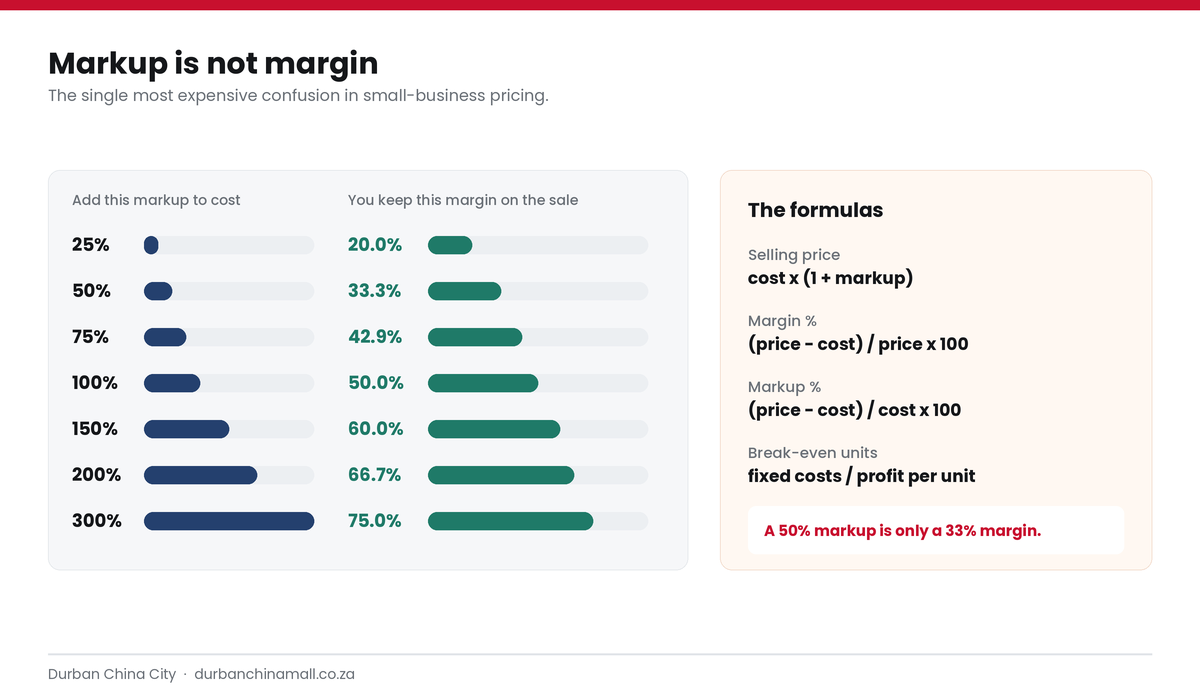
Markup and margin are different numbers and mixing them up is the most expensive error in small trading. A 50 percent markup is only a 33 percent margin. If you needed 50 percent margin and priced with 50 percent markup, you have quietly given away a third of your profit on every single sale.
Markup versus margin
Both describe the gap between cost and selling price. They differ in what you divide by.
- Markup measures the profit against your cost. Buy at R20, sell at R40: profit R20, divided by cost R20, equals 100 percent markup.
- Margin measures the profit against your selling price. Same sale: profit R20 divided by selling price R40 equals 50 percent margin.
Suppliers and wholesalers usually talk in markup. Accountants, banks and anyone looking at your figures talk in margin. Learn to convert between them.
Markup to margin conversion table
| Markup on cost | Equals this margin | R20 cost becomes | Gross profit per unit |
|---|---|---|---|
| 20% | 16.7% | R24.00 | R4.00 |
| 25% | 20.0% | R25.00 | R5.00 |
| 33% | 25.0% | R26.60 | R6.60 |
| 50% | 33.3% | R30.00 | R10.00 |
| 75% | 42.9% | R35.00 | R15.00 |
| 100% | 50.0% | R40.00 | R20.00 |
| 150% | 60.0% | R50.00 | R30.00 |
| 200% | 66.7% | R60.00 | R40.00 |
| 300% | 75.0% | R80.00 | R60.00 |
To convert markup to margin, divide the markup by one plus the markup. A 0.5 markup divided by 1.5 gives 0.333, or 33.3 percent. To go the other way, divide the margin by one minus the margin: 0.5 divided by 0.5 gives 1.0, or 100 percent markup.
Break-even: how many units before you are ahead
Gross profit per unit is selling price minus landed cost. Break-even units is your fixed costs for the period divided by that gross profit per unit.
Say you rent a market stall for R450 on a Saturday and spend R150 on transport. Fixed costs are R600. Your item lands at R24.05 and sells at R49, so gross profit per unit is R24.95. R600 divided by R24.95 is 24.05, so you must sell 25 units before the day earns you anything. If you know you can only realistically sell 30 units at that stall, the maths says the pitch is too expensive or the price is too low.
Run this calculation before you book anything with a fixed fee. It is the single most useful sum in trading.
Pricing for different channels
The same product should not carry the same price everywhere, because each channel carries different costs and different customer expectations.
| Channel | Typical markup range | What the price must cover |
|---|---|---|
| Market or flea stall | 80 to 150% | Pitch fee, transport, a whole day of your time, cash-only round numbers |
| Street or taxi-rank trade | 60 to 120% | Transport, high volume, small basket, note-friendly prices |
| Online (Marketplace, TikTok, WhatsApp) | 80 to 200% | Photos, chatting to buyers, no-shows, delivery or courier, payment fees |
| Supplying other resellers | 25 to 50% | Volume with low effort per unit, but they must still make money |
| Corporate or bulk order | 30 to 60% | Long payment terms, quoting time, the risk of a cancelled order |
These are broad planning ranges at the time of writing, not rules. If you sell to other resellers, remember that your price is their cost. Price so that they can still double it and sell, or they will not come back.
Psychological pricing in rand
South African cash trade has its own rules, and they are not the same as an online store’s.
- Round numbers win in cash. At a rank or a stall, R20, R50 and R100 move faster than R47 because nobody wants to hunt for change and you do not want to carry coins.
- R99 and R199 still work online, where change is not a factor and the first digit does the work.
- Price the bundle, not the item. “3 for R100” reads better than “R35 each” and lifts your basket size.
- Never end a premium item in 99. If you are selling something as good quality, R450 signals more confidence than R449.
- Give a reason for a high price. “Braided cable, one-year replacement” justifies R79 next to a R45 cable. Our guide on spotting quality versus cheap stock helps you buy things worth charging more for.
Discounting and bundles
Discounting comes straight off your profit, not off your revenue. Work out what a discount actually costs you before you offer it.
If you sell at a 50 percent margin and give 20 percent off, your margin falls from 50 percent to 37.5 percent, and you must sell about 67 percent more units to make the same money. At a 33 percent margin, a 10 percent discount means you need roughly 43 percent more sales just to stand still. Very few discounts lift volume that much.
Better alternatives to cutting your price:
- Bundle. Three for R100 protects the perception of value and moves slow stock alongside fast stock.
- Add, do not subtract. Throw in a cheap extra rather than dropping the price. It costs you cost price, not selling price.
- Discount for quantity only. Reward a bigger basket, never a single unit.
- Clear dead stock deliberately. A one-day clearance at cost is fine. A permanently lower price is not.
What to do when a competitor undercuts you
Someone will always sell cheaper. Before you drop your price, work through this in order.
- Check what they are actually selling. A cheaper cable is usually a thinner cable. Different product, different price.
- Check your buying price. If they buy by the carton and you buy by the piece, the answer is your buying method, not your selling price. Ask about carton and trade pricing, and read how to bargain politely on quantity.
- Compete on something other than price. Delivery, a guarantee, being reachable on WhatsApp, having stock when others do not, or simply being pleasant.
- Move up, not down. Sell the better version at a higher price to people who are tired of replacing the cheap one.
- Only match if the maths still works. If matching them takes you below landed cost plus a real profit, let the sale go. A sale that loses money is worse than no sale.
If you are still choosing what to sell, our 20 small business ideas from China Mall stock lists typical margins by product type, and starting a reselling business with R1,000 shows the full cycle with worked numbers.
Frequently asked questions
What is the markup formula in South Africa?
Markup percentage equals selling price minus cost price, divided by cost price, multiplied by 100. To find a selling price from a markup, multiply your cost by one plus the markup as a decimal. A R20 item with a 100 percent markup sells at R40. Use landed cost, not the till slip price, as your cost.
What is the difference between markup and margin?
Markup measures profit against your cost, while margin measures the same profit against your selling price. Buying at R20 and selling at R40 is a 100 percent markup but a 50 percent margin. Suppliers usually talk in markup and accountants in margin, so always confirm which one is meant.
How much should I mark up wholesale products?
For small items sold face to face, 80 to 150 percent markup is common. Bulkier or higher-value goods usually carry 40 to 70 percent, and supplying other resellers is often 25 to 50 percent. Start from your landed cost and check the result against what buyers in your area actually pay.
What is landed cost and why does it matter?
Landed cost is the total cost of getting one unit into a customer’s hands: the purchase price plus transport, packaging, payment fees and an allowance for wastage. It matters because pricing off the purchase price alone hides real costs, so a sale that looks profitable can actually be losing money.
How do I calculate break-even for a market stall?
Add your fixed costs for the day, such as the pitch fee and transport, then divide by your gross profit per unit. If costs are R600 and you make R25 profit per unit, you break even at 24 units. Anything below that means the stall costs more than it earns.
Should I lower my price if a competitor is cheaper?
Usually not. First check whether they are selling the same quality and whether they buy in larger quantities than you. Competing on delivery, availability, service or a better version of the product protects your profit. Only match a lower price if it still covers landed cost plus a real margin.
How much does a discount really cost me?
More than most people expect. At a 33 percent margin, a 10 percent discount means you need roughly 43 percent more sales to earn the same money. At a 50 percent margin, 20 percent off requires about 67 percent more units. Bundling or adding a small extra is usually cheaper than discounting.
Put the numbers on paper before you buy
Take a notebook on your next buying trip and write the landed cost worksheet on the first page. Fill it in at the counter, before you pay, for every item you are considering. If the price you would have to charge feels too high for your customers, walk away from that item. Durban China City is at 269 Inanda Road, Springfield Park, open 09:00 to 17:00 seven days a week, with on-site parking, and prices vary by shop, so it pays to compare.
Related guides
If this was useful, these go deeper on the next step:
Tagged: markup, pricing, profit margin, reselling, small business, south africa, wholesale
Read next

Business Insurance for Small Traders in South Africa
The main categories of small business cover explained plainly, why the cheapest quote is usually the narrowest, and how the average clause…
Shop Security and Shrinkage: Stop Stock Loss in Your Shop
The three sources of shrinkage, why paperwork errors cost more than shoplifters, how to design staff theft out rather than police it,…
Counterfeit Goods and the Law in South Africa: Trader Guide
What counterfeit actually means, why generic and unbranded stock is different and legitimate, the due diligence to do before buying, and what…

Cheapest Courier in South Africa for a Small Business
The real delivery choices a small SA seller has, compared on cost, speed, tracking, insurance and rural coverage, plus volumetric weight, packaging…