China Mall Durban Prices: What Things Typically Cost

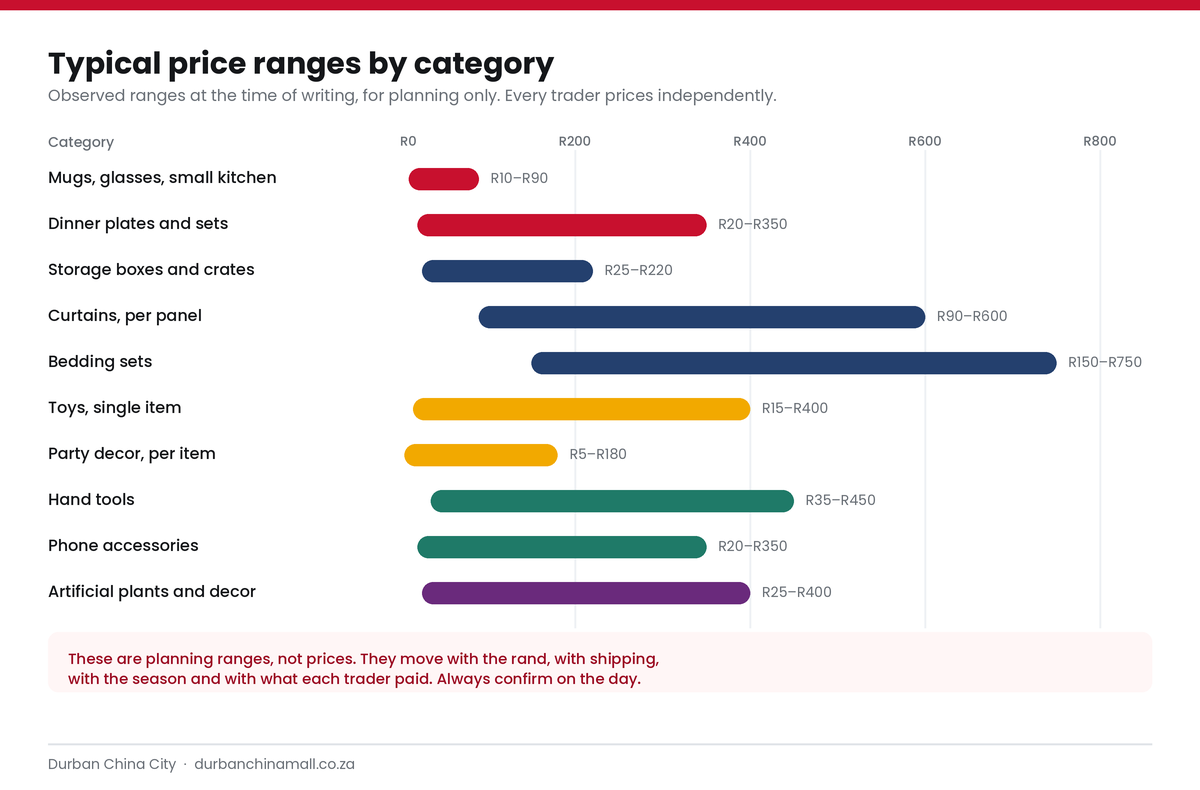
There is no single price list at Durban China City, because every unit is an independent trader setting its own prices. As a rough planning guide, small kitchen and homeware items typically run about R15 to R150, bedding and curtains about R120 to R750, and hand tools about R35 to R450. Prices move constantly.
What this guide covers
- How to read the ranges in this guide
- Kitchen and homeware: typical ranges
- Decor, bedding and curtains: typical ranges
- Toys, party and gifting: typical ranges
- Tools, phone accessories, storage and cleaning: typical ranges
- Why prices differ, and how carton pricing works
- What makes a price genuinely good, and three traps
- Building a realistic shopping budget
- Step one: write the list before you leave
- Step two: put a ceiling next to each line
- Step three: split the budget into three buckets
- Step four: walk before you spend the must-have bucket
- Step five: bring the right payment
- Trap one: cheap but you will replace it three times
- Trap two: buying quantity you cannot store
- Trap three: mistaking a low price for a low cost
- Frequently asked questions
- Plan the trip, then check the prices yourself
- Related guides
The honest answer to “how much are things at China Mall?” is that there is no single answer, because there is no single price list. Durban China City is a centre of many independent traders. Each unit buys its own stock, carries its own overheads and sets its own prices, so two units in the same aisle can price a similar-looking item differently and both be perfectly reasonable.
What we can give you is a planning guide. Everything below is a typical observed range at the time of writing. Treat it the way you would treat a weather forecast: useful for deciding what to pack, useless as a promise. Prices move with the rand, with shipping costs, with the season and with what each trader paid for that consignment.
Read the ranges, use them to set a budget, then verify every figure on the day with the trader in front of you. If a number here is out, the trader is right and the article is wrong.
How to read the ranges in this guide
Four things to hold in your head. They matter more than any individual number.
- Every figure is a typical range, not a price. The bottom is the most basic version of an item; the top is a heavier or better-finished one.
- Prices are not set by the centre. Each trader prices independently, and nobody is obliged to match anybody.
- Ranges age quickly. An exchange-rate move or a new shipping cycle can shift a whole category within weeks.
- Single-unit and carton pricing differ. The ranges below lean towards single-unit retail. Carton pricing is covered further down.
Every price in every table on this page is a typical range observed at the time of writing, given purely as a planning aid. It is not an official price, not a quote, and not a guarantee. Individual traders set their own prices and change them whenever their costs change. Always confirm on the day.
Kitchen and homeware: typical ranges
This is the category most people come for, and the one with the widest spread between the cheapest and the sturdiest version of an item. A pot at the bottom of the range and a pot at the top are genuinely different products.
| Item | Typical range (single unit) | What moves it up the range |
|---|---|---|
| Mugs and glasses, each | R10 – R45 | Thicker glass, printed design, boxed sets |
| Dinner plate, each | R20 – R70 | Porcelain over melamine, weight, glaze quality |
| Cutlery set (16–24 piece) | R120 – R450 | Gauge of the steel, handle finish, storage case |
| Non-stick frying pan | R80 – R350 | Base thickness, coating layers, handle fixing |
| Pot set (3–5 piece) | R350 – R1,400 | Stainless over aluminium, encapsulated base, lids |
| Plastic storage jars and canisters | R25 – R120 | Size, seal quality, food-grade plastic |
All figures above are typical observed ranges at the time of writing. Prices move constantly and each trader sets their own. Our kitchenware and crockery guide goes deeper on what to look for in each item.
Decor, bedding and curtains: typical ranges
| Item | Typical range | Notes |
|---|---|---|
| Scatter cushion cover | R35 – R140 | Inner usually priced separately |
| Cushion inner | R40 – R120 | Weight of filling is the main variable |
| Ready-made curtain panel | R120 – R500 | Drop length and lining drive the price |
| Duvet cover set (queen) | R220 – R750 | Thread feel, print quality, pillowcase count |
| Small rug or mat | R90 – R450 | Backing quality, pile density |
| Table lamp | R150 – R600 | Base weight, shade, cable and plug quality |
Typical observed ranges only. Confirm on the day. Bedding and curtain prices swing most on size, so measure your beds and windows before you leave home.
Toys, party and gifting: typical ranges
| Item | Typical range | Notes |
|---|---|---|
| Small pocket-money toy | R10 – R60 | Common carton lines, cheaper per unit in bulk |
| Mid-size toy (ride-on, playset) | R150 – R900 | Plastic thickness and moving parts |
| Balloons, bulk bag | R30 – R150 | Latex weight, print |
| Themed party set (plates, cups, napkins) | R60 – R250 | Guest count is the main driver |
Typical ranges at the time of writing, subject to change. Safety checks matter more than price here, especially small parts, cords and battery compartments on anything bought for a young child.
Tools, phone accessories, storage and cleaning: typical ranges
| Item | Typical range | Notes |
|---|---|---|
| Hand tools (hammer, pliers, spanner) | R35 – R180 | Weight in the hand tells you a lot |
| Screwdriver or socket set | R80 – R450 | Piece count and case quality |
| Extension cord or multiplug | R60 – R280 | Cable gauge and SABS-type plug fitment |
| Phone charger or cable | R30 – R180 | Cable thickness, connector fit |
| Earphones or small speaker | R60 – R450 | Driver quality, battery size |
| Plastic storage crate or drawer unit | R70 – R500 | Volume and wall thickness |
Typical observed ranges only. Each trader prices independently. More detail sits in the hardware, tools and DIY guide.
Why prices differ, and how carton pricing works
Why two stalls in the same centre charge different prices
New shoppers sometimes find this frustrating. It is worth understanding, because once you do, you shop far better.
- They bought at different times. Stock landed in different months at different exchange rates and freight costs. A trader who imported at a stronger rand can price lower without earning less.
- They bought different quality. Two kettles that look alike from three metres away can have very different internals. The dearer one is often the better buy.
- They carry different overheads. Unit size, position, staff numbers and stock-holding costs all differ.
- They have different strategies. Some price thin and live on volume; others carry a narrower, better-finished range.
- Old stock versus new. A trader clearing the last of a line may price it to move. One who just took delivery will not.
The practical response is simple: walk the category before you buy it. Look at three or four units carrying the same kind of item, note prices, then go back to the best combination of price and build. That walk routinely saves real money.
Single units versus carton pricing
Most units will sell you one of something. Most will also sell a sealed carton, and the per-unit carton price is where the value sits. Roughly how it works:
| Buying level | What it usually means | Typical effect on unit price |
|---|---|---|
| Single unit | One item off the shelf, marked price | Highest per-unit price |
| Full sealed carton | The trader’s natural selling unit | Meaningful drop per unit |
| Several cartons, mixed lines | A genuine wholesale order | Best per-unit price available |
We deliberately give no percentages there, because the gap varies enormously by category and by trader. Ask directly instead: “what is the price if I take the full carton?” That one sentence is the most useful thing you can say on the floor. Our guide to buying wholesale explains carton quantities and minimums, and the bargaining guide covers how to ask without being rude.
What makes a price genuinely good, and three traps
Four tests for a good price
A low number is not automatically a good price. A good price is the lowest total cost for the outcome you actually need.
- Cost per use. A R90 pan you replace every eight months is dearer over three years than a R260 pan you keep.
- Cost per person or per event. For party, catering and decor buys, the number that matters is rand per guest, not rand per packet.
- Landed cost, not shelf price. Add the petrol and the trip back if you underbought. A dearer item bought in one trip can beat a cheaper item bought in two.
- Margin room, if you resell. A good buying price still leaves a healthy margin at the price your customers will actually pay. Work backwards from the selling price.
If you are buying to resell, read how to price products for resale in South Africa before placing a big order.
Building a realistic shopping budget
A simple method that works for household shoppers and small traders alike.
Step one: write the list before you leave
Not a vague list. An itemised one, with a quantity next to each line. Vague lists get expensive.
Step two: put a ceiling next to each line
Use the ranges above. Write the number you are willing to pay, not the number you hope to pay. If nobody meets it, you drop the line rather than overspend.
Step three: split the budget into three buckets
| Bucket | Share of budget | What it covers |
|---|---|---|
| Must-haves | About 60% | The items you came for and will not leave without |
| Nice-to-haves | About 25% | Items you will buy only if the price is right |
| Buffer | About 15% | Genuine finds, and the thing you forgot |
Step four: walk before you spend the must-have bucket
Note prices and unit numbers as you go. Shop numbers use a letter-and-number format such as C12 or E37, so jotting them down makes it easy to go back.
Step five: bring the right payment
Payment arrangements differ from trader to trader, so plan for both cash and card and confirm at the counter. The payments, cards and refunds guide covers this in full.
Trap one: cheap but you will replace it three times
You save R120 today and spend R240 over two years replacing it, plus the petrol for two extra trips. This trap is worst in anything with a moving part, a heating element, a coating or a seam under load. Kettles, pans, zips, hinges, cables and motors deserve the extra rand.
Trap two: buying quantity you cannot store
A carton price is only a saving if you use the carton. Boxes stacked in a passage get damp, sunned, stepped on and forgotten. Ask three questions first: where will it live, how long will it take to move, and does it deteriorate while it waits? Textiles and paper dislike damp, print dislikes sunlight, and anything with a battery has a shelf life.
Trap three: mistaking a low price for a low cost
Price is what leaves your hand at the till. Cost is price plus everything after it: replacement, repair, returns, storage, and reputation if you resell something that fails. One bad line can cost a reseller more in refunds than the entire margin it earned.
Before any purchase over a few hundred rand, ask yourself out loud: “if this lasts half as long as I hope, was it still worth it?” If the answer is no, step up a quality level or leave it. Our guide on spotting quality versus cheap stock shows you exactly what to check in your hand.
Frequently asked questions
Frequently asked questions
How much are things at China Mall Durban?
It depends on the item and the trader. As a rough guide, small homeware and kitchen items commonly fall between R15 and R150, bedding and curtain items between about R120 and R750, and hand tools between about R35 and R450. These are typical ranges at the time of writing, not official prices.
Is there an official price list for Durban China City?
No. Durban China City is a centre of independent traders with no central price list. Each unit buys its own stock and sets its own prices, which is why the same type of item can cost different amounts in different aisles. Any online price guide, including this one, is an estimate.
Why is the same item cheaper in one shop than another?
Traders bought their stock at different times, at different exchange rates and in different qualities. They also carry different overheads and pricing strategies. Two similar-looking items are often not the same product, so walking the category before you buy is the simplest way to find the right combination of price and build.
Do I get a better price if I buy a full carton?
Usually yes. A sealed carton is the natural selling unit for most traders, so the per-unit price normally drops when you take one. The size of the drop varies by category and trader, so ask directly. Only buy a carton if you can genuinely store and use the whole quantity.
How much should I budget for a first shopping trip?
Set the budget from your list, not the other way around. Write every item with a quantity, put a ceiling price next to each line using typical ranges as a guide, then split the total roughly 60 percent must-haves, 25 percent nice-to-haves and 15 percent buffer.
Are prices at China Mall Durban negotiable?
Sometimes, and mainly on quantity. Fast-moving items at clearly marked low prices often carry thin margins and little room to move. Larger orders, full cartons and several items from one stall are where a trader can genuinely do better. Ask politely, and accept the answer either way.
What are the trading hours if I want to compare prices in person?
Durban China City trades from 09:00 to 17:00, seven days a week, at 269 Inanda Road, Springfield Park. Public holiday hours can differ, so phone 031 577 1615 before you travel. Arriving earlier gives you more time to walk several units and compare before the aisles get busy.
Plan the trip, then check the prices yourself
Use this guide to set expectations and build a budget, then let the shop floor correct you. The traders in front of you have the only prices that count. Come with a list, a ceiling per line, and the patience to ask what the carton price is.
Durban China City269 Inanda Road, Springfield Park, Durban, 4001
KwaZulu-Natal, South Africa
+27 31 577 1615
Open in Google Maps
Related guides
If this was useful, these go deeper on the next step:
Tagged: cheap homeware durban, china mall durban prices, price guide, shopping budget, springfield park, wholesale prices durban
Read next

How to Price Products to Sell More: Pricing Psychology
Anchoring, charm pricing, bundles, round numbers for cash, and raising prices without losing regulars, with a clear line between effects that hold…

How to Spot Quality Stock at China Mall Durban Before You Buy
How to check quality before you buy in bulk: general hand tests, category checklists for textiles, plastics, glass, metal, electricals and cosmetics,…

How to Bargain at China Mall Durban Without Being Rude
A respectful, practical guide to haggling at China Mall Durban: when it is appropriate, the phrases that work, what discount to realistically…